
1. What the green ring actually is
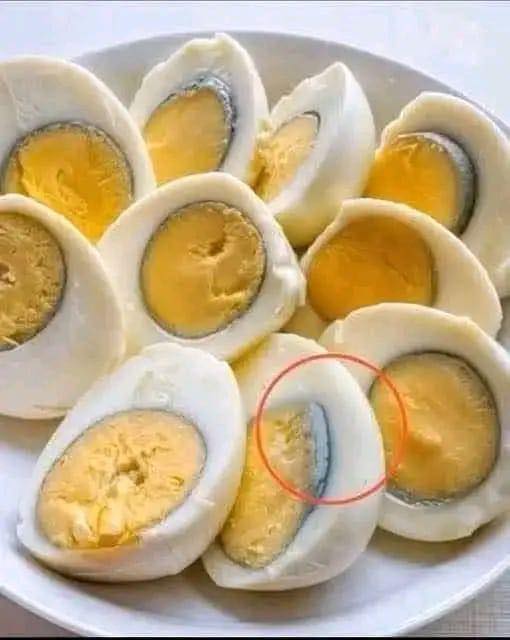
The green or grey ring that appears around the yolk of a hard‑boiled egg is typically due to a compound called ferrous sulfide (also called iron sulfide). At the boundary between the egg white and yolk, sulfur released from the white combines with iron from the yolk, resulting in a deposit of ferrous sulfide, which has a greenish‑gray colour.
In more detail: the egg white contains sulfur‑bearing amino acids (such as cysteine, methionine) which, when heated sufficiently, release hydrogen sulfide (H₂S) gas. Meanwhile, the yolk contains iron in various forms. The hydrogen sulfide migrates toward the yolk / boundary and reacts with iron to form the greenish ring of ferrous sulfide.
It generally appears at the interface of the yolk and white because that’s where the sulfur gases emanating from the white reach the iron‑rich yolk.
Because the colour is purely a chemical change and not a sign of spoilage, the egg is still safe for consumption.
2. Why the reaction happens (time, temperature, chemistry)
a) Overcooking
One of the main drivers for the formation of the green ring is overcooking the egg. The longer the egg is subjected to high heat, the more the egg white’s proteins break down and release sulfur, the more hydrogen sulfide is generated, and thus the more iron in the yolk is triggered to react.
According to one source: “The #1 cause is cooking the eggs too long. Even 5–10 minutes past ideal time can trigger the sulfur‑iron reaction.”
b) High temperature / rolling boil
Cooking at a high, vigorous boil tends to raise internal egg temperatures more rapidly, and may encourage extra sulphur release and reaction. A rapid rolling boil can intensify the reaction compared with a gentler simmer.
c) Slow cooling / residual heat
Another contributing factor is the failure to cool the eggs quickly after cooking. If the eggs remain in hot water or in residual heat, the chemical reactions continue even after you think cooking is over. That allows more ferrous sulfide to form at the boundary.
d) Age of egg / pH changes
Eggs change subtly in their chemistry as they age. Fresh eggs are harder to peel, and older eggs have a slightly higher pH in the white, which may influence the reaction rate of hydrogen sulfide release and binding with iron. Some sources note older eggs more easily show the green ring.
e) Iron content in cooking water
Less commonly, the mineral content of your cooking water (especially iron levels) can affect how pronounced the green ring becomes. Water with higher iron content may contribute extra iron to the reaction or accelerate it.
3. Is the egg safe to eat when it has a green ring?
Yes — the green ring is harmless. It’s a visual cue of the reaction described but does not, by itself, indicate spoilage or safety hazard. Many authoritative sources state that eggs with a green ring are still wholesome and fully edible.
However, while the ring itself is safe, the conditions that caused it (e.g., overcooking) may affect taste or texture. Overcooked eggs may have rubbery whites, chalky yolks, and a faint sulfur smell.
So while the discoloration is benign, the experience of eating the egg might be less pleasant. But from a food safety standpoint it’s fine.
4. What the green ring tells you (and when it’s more than that)
When you see the green ring, it’s a kind of indicator of cooking technique more than of egg quality. It tells you that your eggs were cooked at high temperature or for perhaps too long, or perhaps weren’t cooled promptly. It doesn’t necessarily reflect how fresh the eggs were (though that plays a role) or the health of the bird.
You shouldn’t assume the egg was bad or contaminated simply because of the green ring.
That said, if eggs also have unusual smell (strong sulfur smell beyond the norm), slimy texture, or odd shell damage — those are different signs. In the absence of those, the green ring alone isn’t a concern.
5. How to avoid or minimise the green ring (tips & best practices)
If you’d like your hard‑boiled eggs to have bright yellow yolks with no green ring (especially if you’re serving them whole or in deviled eggs), here are practical steps: